How Much Sleep Does Your Child Need? A Research-Backed Sleep-by-Age Guide
12 min read
Many families spend bedtime negotiating one more story, one more drink of water and one more hug. Nearly half of U.S. children ages 0 to 13 don’t regularly get the amount of sleep the National Sleep Foundation (NSF) recommends for their age, according to its 2026 Sleep in America® Poll.
Current guidance from the American Academy of Sleep Medicine (AASM), supported by the American Academy of Pediatrics (AAP), recommends age-based ranges for total sleep across 24 hours. Individual sleep needs still vary, so these ranges give you a useful reference point rather than one number every child needs to meet.
Teachers at Primrose Schools®, The Leader in Early Education and Care®, care for children across these stages and see how their routines and sleep patterns develop as they grow. Healthy sleep can help children focus, feel confident, manage big feelings and get ready for school.
You can pair that classroom experience with current research to understand how much sleep your child needs by age, where naps fit and what healthy sleep may look like as their needs change.
What Are the Recommended Sleep Hours for Children by Age?
Children need the most sleep during infancy, and the recommended total gradually decreases as they get older. Age-based ranges can help put those changing sleep needs into numbers.
For children from 4 months through age 12, the ranges come from AASM recommendations, which AAP supports. AASM did not set a range for babies under 4 months because sleep duration and patterns vary widely at this age, and there was not enough evidence linking sleep duration with health outcomes.
For newborns aged 0 to 3 months, NSF provides a separate age-based sleep recommendation.
You can use these ranges as a reference for how much total sleep your child may need across a full day.
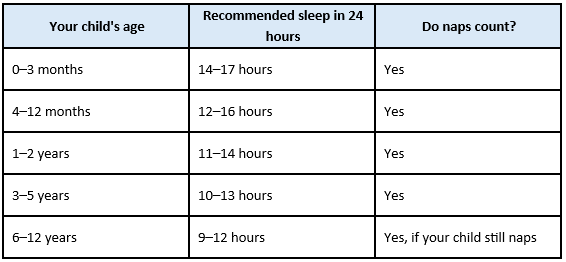
The numbers become more useful once you think in terms of a full 24 hours. If your 2-year-old sleeps for 10 hours at night and 2 hours during the day, for example, their total is 12 hours, which falls within the recommended range for their age.
AAP guidance specifically tells parents to include naps when adding up their child’s typical sleep.
Recommended sleep decreases across age ranges, from 14 to 17 hours for newborns down to 9 to 12 hours for children ages 6 to 12. How children spread those hours throughout the day also changes, particularly as naps become less frequent with age.
🧩 More From Primrose: Good Night, Sleep…Safe?
How Do Sleep Needs Change as Your Child Grows?
Over the first years of life, children gradually move from several periods of sleep across the day and night toward longer stretches at night. Families may see naps become fewer along the way and eventually disappear at different ages, particularly during the preschool years.
To see how sleep develops, you can follow these changes across broader stages, starting with the first year of life and continuing through toddlerhood, preschool and the school years.
1. Infants (0–12 Months)
Infant sleep changes quickly during the first year. Newborns sleep in shorter periods across the day and night, and AAP notes that babies do not develop regular sleep cycles until about 4 months of age.
As babies get older, more of their sleep happens at night. According to a 2026 review in Pediatric Research, the longest period of sleep generally increases across the first year while the number of daily sleep periods decreases.
Night waking can still be part of infant sleep as longer nighttime stretches develop.
2. Toddlers (1–2 Years)
Toddlers still get part of their daily sleep through naps, but daytime sleep gradually becomes less frequent as they get older. Some children move from several daytime sleep periods in infancy toward one regular nap during the toddler years.
In a systematic review and meta-analysis of napping patterns in children ages 0 to 12, fewer than 2.5% of children stopped napping before age 2. For most toddlers, naps therefore remain part of their total daily sleep even as their sleep schedule begins to change.
Primrose school teachers in Toddler, Early Preschool and Preschool Pathways classrooms use experience cards on bedtime and quiet-time routines. Children look at the cards, talk about each step and act the steps out. Primrose classrooms also use a sign language card for nap time.
At home, you can try a similar idea with a simple picture for each step of your toddler’s nap routine, then invite your toddler to act it out.
3. Preschoolers (3–5 Years)
Preschool is the stage when nap patterns can vary considerably from one child to another. Some children at this age may still sleep during the day, while others get their full daily sleep at night.
The systematic review of napping patterns also found that 94% of children had stopped napping by age 5, with the largest variation in nap patterns occurring between ages 3 and 5.
Preschoolers who no longer nap may have a different daily schedule from classmates of the same age who still need daytime sleep.
4. School-Age Children (6–12 Years)
By school age, most children get their daily sleep at night as regular naps become less common. Their total sleep needs continue to decrease with age, but the 9 to 12 hours recommended for children ages 6 to 12 will usually come from nighttime sleep.
Occasional daytime sleep can still count toward your child’s total over 24 hours. For families, bedtime and wake time now account for most of the daily sleep schedule, which makes nighttime routines increasingly important.
🧩 More From Primrose: Help! My Baby Won’t Sleep Through the Night

How Can You Help Your Child Get Enough Sleep?
Your child’s age-based sleep range, usual wake time and any naps can help you plan a daily schedule that leaves enough time for sleep.
At Primrose, teachers adapt rest to children’s age and individual needs. Infant teachers follow each baby’s own schedule and cues, while older children’s days include rest alongside learning, play and meals in a routine suited to their age.
Parents can take a similar approach at home by adjusting sleep times as their child’s needs change. You can make that plan easier to follow with a few daily habits:
- Keep bedtime and wake time regular. Try to keep sleep and wake times the same from day to day, including weekends when possible. For younger children who still nap, similar nap times can also create a steady daily rhythm.
- Build a calm routine before bed. Choose a few simple steps your child can expect each night. The AAP’s Brush, Book, Bed routine offers one example where children brush their teeth, read together with a parent or caregiver and follow a set bedtime each night. Your child can begin to recognize those steps as signals that bedtime is approaching. Primrose school teachers also read a book before children get ready for nap or quiet time, which helps children build a habit of calmly reading a story before they rest. In another lesson, children read a book about nighttime and act out the sequence of the story, an example of the purposeful play that Balanced Learning® blends with nurturing guidance from teachers.
- Put screens away before bedtime. Try to turn off TVs, tablets, phones and other screens at least 1 hour before bed and keep them out of children’s bedrooms at night. Use that hour for relaxing activities that can help your child wind down.
- Make daytime activity part of the routine. Physical activity, time outdoors and bright light earlier in the day can support a healthy sleep-wake schedule. As bedtime gets closer, less active play can help your child prepare for sleep. In Primrose classrooms, children build coordination and balance through Thumbs Up!® movement activities and learn how exercise and rest help the body stay healthy and strong.
- Create a comfortable place to sleep. Keep the room quiet, dim the lights before bedtime and avoid overheating. For babies under age 1, AAP safe sleep guidance recommends placing your baby on their back on a firm, flat sleep surface without loose bedding or soft objects. In one Primrose lesson, children design a shelter for a bear to rest in during winter. Ask your child what would make their own sleep space cozy.
Pay attention to how your child seems during the day, too, as too little or poor-quality sleep may show up as trouble paying attention, zoning out or falling asleep at school.
If you notice these signs, try writing down your child’s bedtime, wake time, naps and anything unusual about their sleep for several days. You can use your notes to look for patterns and share them with your pediatrician if your concerns continue.
As your child gets older, they can take a more active role in their bedtime routine. You can help them learn to repeat each step on their own by keeping the ritual familiar, so they can begin to set up good conditions for sleep without you and build independence.
🧩 More From Primrose: Helping Your Child Develop Healthy Sleep Habits
FAQ About Children’s Sleep
Your child’s sleep can still raise questions that don’t fit neatly into an age-based range or bedtime routine. Here are answers to a few that families may encounter as their children grow.
1. What if my child sleeps more or less than the recommended range?
Children’s sleep needs vary, so the recommended range gives you a useful guide rather than an exact amount every child needs to reach each day.
If your child regularly sleeps much more or less than the range for their age and you are concerned about their sleep, talk with a healthcare provider.
2. Can my child catch up on sleep by sleeping later on weekends?
Your child may sleep a little later on weekends after getting less sleep during the week, but large differences in wake time can make it harder to return to their usual schedule.
By the middle-school years, aim to keep your child’s weekend wake-ups within about 1 hour of their usual time, which makes it easier to return to their weekday schedule.
3. Is melatonin safe for children?
Melatonin may be appropriate for some children, but its safety and usefulness depend on the child and the reason they are having trouble sleeping. AAP’s melatonin guidance says parents should discuss it with their pediatrician first and have healthy sleep habits in place before considering a supplement.
U.S. melatonin supplements are not regulated as medications, and the amount of melatonin in a product may differ from what the label states. Studies have found short-term use relatively safe, while less is known about longer-term use in children.
Your pediatrician can help determine whether melatonin is appropriate for your child and advise you on the timing and dose, so avoid giving melatonin or choosing a dose on your own.
4. What sleep problems should I discuss with my child’s pediatrician?
Ongoing trouble falling asleep, frequent nighttime waking, snoring and loud or heavy breathing during sleep are all reasons to discuss your child’s sleep with their pediatrician.
If your child snores frequently or has breathing problems during sleep, they may need to be evaluated for sleep apnea, so talk with your pediatrician if you notice these symptoms.

How Primrose Schools Support Healthy Routines as Children Grow
For more than 40 years, Primrose Schools, The Leader in Early Education and Care, has served children from 6 weeks to 12 years old, and this franchise now includes 570+ locally owned and operated schools across the country that welcome families.
We believe who children become is as important as what they know. That belief shapes Balanced Learning®, the Primrose approach that blends purposeful play with nurturing guidance from teachers to build curiosity, creativity, confidence and compassion in children.
In Primrose classrooms, teachers bring Balanced Learning to life in ways that care for children’s minds and bodies as they grow.
- Active Minds, Healthy Bodies and Happy Hearts®: Children develop physical skills alongside cognitive and social-emotional skills, with Healthy Bodies focusing on physical development, movement and healthy habits. The framework extends across Primrose programs from infancy through age 12.
- Thumbs Up!: Children build body awareness and practice teamwork through age-appropriate movement and physical activities. Regular opportunities to move also help children form healthy habits as part of their day.
- Taking Care of Myself and My Environment: Children practice everyday self-care and learn to take responsibility for themselves and their surroundings.
First Things First reports that 90% of a child’s brain develops in the first five years. Primrose school teachers use everyday classroom experiences to nurture children’s learning, physical development and social-emotional growth during these early years.
In a Spring 2024 assessment with the Bracken School Readiness Assessment, 4th Edition, 97% of Primrose Pre-Kindergarten students demonstrated kindergarten-readiness benchmarks.
Find a Primrose school near you to learn more about the school’s approach to healthy routines, including how teachers help support children’s rest and well-being throughout the day. Each school is independently owned and operated, so program details may vary by location.