
Nov 02, 2026
Baumrind’s 4 Parenting Styles Explained: A Research-Backed Overview for New Parents
13 min read
Every parent leans on more than one parenting style, whether they realize it or not. You might hold a firm line at bedtime and let mismatched socks slide by breakfast. Sometimes styles change within the same hour.
In the 1960s, psychologist Diana Baumrind spent years watching parents and their preschoolers up close and noticed patterns that kept repeating. Other researchers built on her work, and the four categories that resulted are still what most parenting conversations come back to today.
As The Leader in Early Education and Care® for more than 40 years, we see all four styles every day, including the newer labels like gentle parenting and helicopter parenting. So, are you locked into one parenting style or moving between all four depending on the day?
Let’s find out.
What Are Baumrind’s 4 Types of Parenting Styles?
The four types of parenting styles come from a framework built by developmental psychologist Diana Baumrind. Baumrind studied how parents everyday behavior shapes their children’s growth. In the 1960s, she watched parents and their preschoolers together.
She grouped what she saw into three original styles: authoritarian, authoritative and permissive. In 1983, researchers Eleanor Maccoby and John Martin added the fourth style: uninvolved parenting. They also introduced the warmth-and-structure framework that ties all four together.
Here’s a quick look at all four parenting styles:

You probably recognize more than one of these in yourself, depending on your child’s age and current needs, or even how much patience is left by dinnertime. Firm redirects at the playground and flexible bedtimes are simply individual moments that are part of a much longer pattern.
Baumrind’s research doesn’t capture every family or culture, and these four styles work best when you use them to talk about patterns you recognize in your own family.
1. Authoritarian Parenting: High Structure and Low Warmth
Authoritarian parenting is a strict style featuring high demands, rigid rules and low emotional responsiveness, where children are expected to follow directions.
For example, your little one planted their feet and refused to leave the playground at pickup. As an authoritarian parent, you gave one firm direction to leave right away and held that line no matter the protest that followed.
The authoritarian approach usually results in quick compliance, but it gives your child fewer chances to practice managing their own feelings, since they aren’t given a say in the outcome.
According to Sanvictores and Mendez (2022), children raised through authoritarian parenting tend to follow directions well, largely out of fear of consequences rather than willing cooperation. The same approach also comes with higher aggression, more trouble making their own decisions and lower self-esteem. As children grow older, the strict rules and punishments can drive them to rebel against authority figures.
Stepping in firmly for one moment still has its place, like grabbing your toddler’s hand before they dart into a parking lot. In high-risk moments where safety leaves no room for explanation, the authoritarian approach can be the most suitable, even necessary, one.
🧩 More From Primrose Teachers: 7 Tips to Tame Tantrums
2. Authoritative Parenting: Warmth Paired With Clear Limits
Authoritative parenting is a balanced style featuring high demands and high emotional responsiveness, where children get clear limits alongside warmth and explanation.
Say your toddler reached for a favorite stuffed animal on the way out to a muddy backyard and started crying when you said it needed to stay inside. You named the disappointment out loud, explained the toy would need a wash before bedtime and helped them pick a different one to bring outside.
The same pairing played out in a Primrose classroom, where a teacher told a group of children playing outside, “You are having so much fun with your friends outside! We have ten more minutes to play, then it is time for the next plan for our day: lunch! We will come back outside after afternoon snack.”
Primrose school teachers pair warmth with limits. They acknowledge children’s feelings, explain what comes next and set clear expectations.
In both moments, the limit holds. The stuffed animal stays inside, and lunch still follows ten more minutes of play.
This approach lines up with a 2023 study of 321 kindergarten families, where teachers reported better self-discipline and healthier self-esteem in children whose families paired warmth with clear limits.
Research from Sanvictores and Mendez backs this up and adds one trade-off. Authoritative parenting takes more patience and follow-through from you than the other styles do, since explaining a limit and staying warm while holding it takes more effort than enforcing a rule or letting one go.
3. Permissive Parenting: Warmth Without Firm Limits
Permissive parenting is a lenient style featuring high emotional responsiveness and low demands, where children have few rules and rarely face consequences for breaking them.
For example, your child refused to sit at the dinner table without a tablet, so you dropped the no-screen rule and allowed them to keep it.
Children raised this way tend to become confident and socially warm early on, and research from Sanvictores and Mendez in StatPearls backs that up. These same children can also have more trouble taking responsibility for their behavior or handling frustration without an adult stepping in later on.
Say you skipped your toddler’s nap for one long flight, then went right back to the usual routine you keep the other 364 days of the year. That is a one-time trade-off for a logistical reason. Permissive parenting, on the other hand, looks like reaching for the tablet at dinner most nights, even when there’s no longer a practical reason for it.
🧩 More From Primrose Teachers: 3 Screen Time Tips for Your Family
4. Uninvolved Parenting: Little Warmth or Structure
Uninvolved parenting is a disengaged style featuring low demands and low emotional responsiveness, where children receive minimal guidance or nurturing from a parent.
Children in this pattern spend long stretches of the day self-soothing or entertaining themselves, without much interaction from a nearby adult.
Research from Sanvictores and Mendez connects this pattern with resilience and early self-sufficiency in some children, though these skills tend to develop out of necessity. The same research links it to more difficulty regulating emotions, weaker coping strategies, struggles in school and trouble maintaining or nurturing social relationships later on.

How Do Early Interactions Shape a Developing Brain?
Early interactions wire a developing brain, one small connection at a time. Every coo you answer and every cry you comfort strengthens that growing network. You’ve been doing this work since day one.
“Serve and Return” Interactions and Early Brain Development
These back-and-forth exchanges with your baby, such as handing over a toy they reach for, build the neural connections behind language, social skills and self-regulation. The Center on the Developing Child at Harvard University calls this pattern “serve and return.”
These interactions can be so subtle that we may take them for granted, such as:
- Your baby babbles, and you babble something back.
- Your baby smiles, so you smile in return.
- Your baby looks toward something, and you name what they see.
- Your baby makes a gesture, and you respond with a word or action.
Teachers at Primrose schools pay attention to these subtle invitations for connection as they support each child’s development. Serve and return is part of every step of the Primrose Balanced Early Learning Cycle. Teachers are trained to continue conversations and ask open-ended questions that promote language development, critical thinking and engagement.
In our Infant classrooms, for instance, teachers narrate ordinary moments out loud, naming a color while buttoning a onesie or echoing a babble word for word, so a diaper change becomes another serve and return. Try it the next time you’re getting your baby dressed.
🧩 More From Primrose Teachers: Wired for Learning, Part 2: The Language Tennis Game
How Prolonged Stress Without Support Affects Early Development
When you comfort your baby, you’re helping protect their developing brain and body from the wear that prolonged, unsupported stress can cause. That wear can show up in different ways, such as in how your little one handles new challenges.
Just by showing up, you also teach your baby’s whole body how to calm down after something stressful. The Center on the Developing Child at Harvard University calls this protective effect “buffering,” since a caring adult’s steady presence softens the impact of stress before it can overwhelm a child’s developing system.
Whichever parenting style guides your day, you build that protection when you show up for your child in a hard moment.
🧩 More From Primrose Teachers: 5 Calming Techniques to Help Children Work Through Big Feelings
Where Do Gentle Parenting, Helicopter Parenting and Other Modern Labels Fit?
Today’s popular parenting labels mostly fit somewhere within Baumrind’s four styles, though a few blend a bit of each.
- Gentle parenting, RIE and attachment parenting all center on responsiveness and connection. Add clear, age-appropriate limits to that responsiveness, and it becomes authoritative parenting under a different name. Drop the limits, and the same warmth can drift toward permissive.
- Free-range parenting looks a lot like permissive parenting when it comes to structure. If this describes your instincts, you’re trusting your own judgment about everyday risk over a strict rulebook. Let Grow, the nonprofit Lenore Skenazy co-founded after popularizing the term, calls it a deliberate return to the independence past generations of children had.
- Tiger parenting pairs high academic and behavioral demands with less warmth. Think of it as authoritarian parenting focused squarely on academics. You’ll recognize it if high expectations come with little room to explain the reasoning behind them.
- Helicopter and snowplow parenting usually come from wanting the best for your child. If you find yourself stepping in before your child even hits a snag, that’s probably you. Research on the topic hasn’t settled on whether that instinct comes from a warm, connected place or a more anxious one. It really depends on the family.
- Lighthouse parenting, a term coined by pediatrician Kenneth Ginsburg of the Center for Parent and Teen Communication, describes a steady, visible presence while your child works through a challenge on their own. It’s another name for authoritative parenting, too.
See where each parenting style falls on this chart of structure and warmth, and notice where your own moments tend to land. 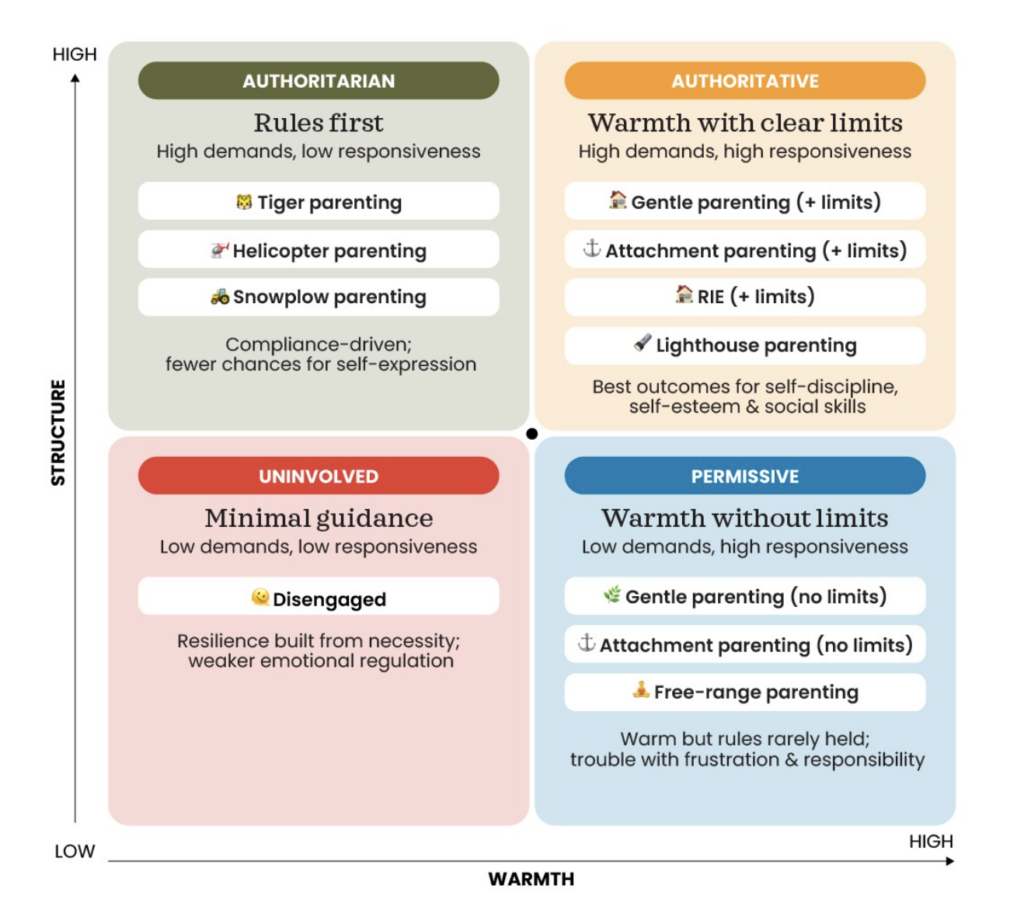
You don’t need the exact right label. Primrose teachers see every one of these labels walk through their doors in some form, and warmth paired with limits is still what helps your child, whichever term got you there.
Frequently Asked Questions About Parenting Styles
These are the questions we tend to hear from parents as they think through which patterns fit their own family.
1. What if my partner and I use different parenting styles?
Different parenting styles aren’t inherently harmful. It is how parents handle and coordinate their different styles that can produce a negative impact.
According to C. Liu and M. Rahman, a solid coparenting alliance can help protect children from the effects of differing parenting styles, even when one parent is stricter. Researchers at the University of Nebraska-Lincoln also concluded that destructive conflict is what predicts insecurity.
2. Is it too late to switch to authoritative parenting?
No, parents can switch between styles based on their child’s current needs. Start with the next moment that calls for a boundary, no matter your child’s age or the patterns you’ve used so far.
3. Does authoritative parenting cause anxiety in children?
Not really. Children do well with warmth paired with age-appropriate limits. The anxiety risk traces back to parental perfectionism and overcontrol specifically, patterns that look different from warmth plus structure.

How the Primrose Schools Balanced Learning® Approach Supports Every Parenting Style
Primrose Schools is The Leader in Early Education and Care. For more than 40 years, we have served children from 6 weeks to 12 years old.
We believe who children become is as important as what they know. That belief shapes Balanced Learning®, our approach that blends purposeful play with nurturing guidance from teachers. Together, they inspire curiosity, creativity, confidence and compassion, what we call Active Minds, Healthy Bodies and Happy Hearts®.
Primrose pairs nurturing relationships with steady guidance. Through trusted teacher-child connections, predictable routines, clear expectations and child-led learning experiences, we help children build confidence, responsibility and positive relationships with others.
Across Primrose classrooms, teachers bring that approach to life in the following ways:
- Rules of the Roost: Children learn that rules help everyone play, learn and stay safe together. Teachers set clear, positive expectations, so children understand boundaries and build responsibility and respect for others.
- Wonder Time and Small Group Learning: In Wonder Time, part of the Wonder Program that runs from Infant through Preschool Pathways, teachers build trusted relationships through responsive interactions, conversations and open-ended questions that encourage children to think, communicate and explore new ideas. In Preschool through Kindergarten, small-group experiences help children practice collaboration, problem-solving and listening to others.
- Children’s Choice Learning Centers: Children choose which center to play in, how to use its materials and how long to stay, which builds independence and confidence. Teachers offer guidance and support as children need it, and children practice creativity, cooperation and self-directed exploration.
- Clean Up: Children clean up together every day, which gives them practice with responsibility, teamwork and respect for their classroom community. By caring for their shared space, they learn that their actions help the people around them.
- Classroom Helper Chart: Children take on classroom jobs such as passing out materials, caring for the classroom or helping a classmate, and each job builds confidence, responsibility and a sense of belonging. Along the way, they learn leadership, cooperation and how contributing helps their community.
90% of a child’s brain develops in the first five years (First Things First). That’s why Primrose builds warmth and structure, matched to each child, into everyday moments from day one.
That focus shows results. 97% of Primrose Pre-Kindergarten students demonstrated kindergarten-readiness benchmarks (Bracken School Readiness Assessment, 4th Edition, Spring 2024).
Primrose Schools® has 570+ schools across the country, so there’s likely one near you. Your local Primrose school can help your little one grow at their own pace, whatever parenting style guides your home.
Start by scheduling a personalized campus tour and see Balanced Learning® in action for yourself. You’ll see how a Primrose classroom meets your child exactly where they are.